Picture a small handmade dessert shop. The owner has just finished a one-page website. At the very top is a photo of beautiful sweets with the shop name, and a button to order through LINE. One evening a stranger finds the shop from a post a friend shared. They open the website, see the sweets filling the screen, and scroll down just a little to find the story section sitting right below the first image. They stop and read there longer than anywhere else. Purple Bear bets they did not stop because they wanted the history of the shop. They were wondering in their head, "Is this shop real? If I send money, what happens?"
This made Purple Bear want to look at the story section in a new way. It is not a place to write a nice-looking history. It is a place to quietly answer the questions in the mind of someone who does not know you yet. Today we will see how many of those questions there are, and what to answer each one with.
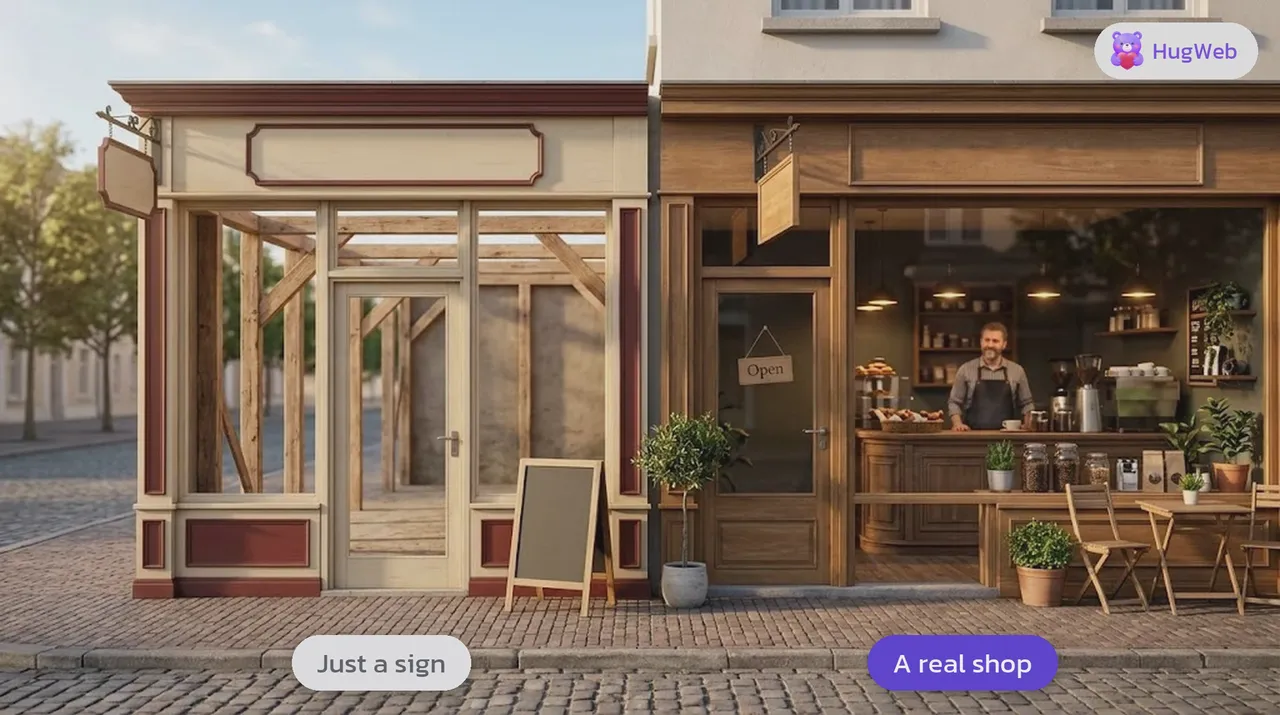
A stranger is not here to read your story, they are checking
When shop owners sit down to write the About section, they usually write from their own feelings first. How they started, what they love, what they care about. All of it is true and lovely. But most people who scroll to this section have not yet formed a bond with your shop. They are still in checking mode.
There is a principle that makes this clearer: the web credibility guidelines from a Stanford University lab, published in 2002 (Stanford Guidelines for Web Credibility). It is old, but it still holds up very well. Three items on the list speak directly to a story section: show that a real organization stands behind the site, make it easy to contact you, and make it easy to verify the accuracy of your information. Note that this is a principle from abroad, not a figure from Thai buyers, so Purple Bear uses it as a way of thinking, not as a statistic.
Let us translate it into the language of a small shop. It becomes 3 questions that a stranger silently asks, all at once, often without realizing it.
- Who is behind this shop?
- Does this shop really do what it says?
- Can I really reach them?
If the story section answers all 3, the reader feels safe enough to go on. If it does not, however nice the story is, they may scroll past with some doubt.
Answers that can be checked are what build trust.
On a one-page website, this section usually sits right under the first image
HugWeb builds websites as a single page made of sections that you scroll through one after another, and the owner can edit each section. On a one-page website, the About section is usually placed right under the top section called the hero, which is the big image, the shop name and the first button that people see the moment they open the site.
That position makes the story section the first checkpoint. The reader has only just seen the image and the name. They have not seen the products yet, and have not seen the menu or services. They scroll down once and arrive here, and they use this section to decide whether to keep scrolling to the products or to close the page.
Once you understand this position, you can see that the section needs to be short enough to pass quickly, because the reader still wants to see the products, and it should end with a sentence that leads them onward. Purple Bear suggests writing it with a person scrolling on a phone in mind, reading one screen at a time, not sitting down to read an essay.
Question 1: Who is behind this shop?
People trust people more than they trust shop names. So the first thing this section should do is let the reader see that a real person is behind the screen. A few things help answer this.
- The name of the person who runs the shop A real name or the name customers call you is fine, as long as it is the name you actually use when talking to customers.
- A photo of a real person The owner at work, or the team with the products. It does not need to be a studio shot. A photo taken in your real kitchen or shop always looks more believable than a stock photo.
- A short origin in one or two sentences For example, why you started and how long you have been doing it (include it only if it is true and you can state it clearly).
If you are not comfortable showing your own face, that is fine. A photo of hands at work, of your workspace, or of products you really made also tells the reader that someone is really making them. What matters is that the image belongs to your shop, not one picked up from somewhere else.
One thing to watch out for: do not open with long praise of yourself, such as "we are the best shop". The reader has no way to check a sentence like that, so it does not make them trust you more. Starting with small facts that can be checked works much better.
Question 2: Does this shop really do what it says?
This is the heart of the checking. A stranger wants to see evidence that the shop really does what it writes, not just writes it. There are several kinds of evidence. Choose only what your shop really has.
- Photos of the making process Pictures of production, packing and preparing. They show the products did not come from nowhere.
- Details that outsiders do not know but real makers do For example, where the ingredients come from and how you get this particular taste. Small details like these are harder to fake than advertising.
- Things that can be verified For example, where the shop is, which days it opens, and whether it has a storefront or takes orders from somewhere. If there is a real location, include it so readers can look at the map themselves.
There is one more thing Purple Bear would like to mention. If a shop has registered as an online commercial business, Thailand's Department of Business Development has the DBD Registered mark, which the Ministry of Commerce describes as a mark certifying e-commerce operators and confirming that they really exist (details are on the Ministry of Commerce page, which is in Thai and dated 24 October 2024). If your shop already has this mark, showing it in the story section is evidence that helps answer this question. But the conditions for applying, the timing and the process may change, so please check directly with the Department of Business Development before you act. Purple Bear is not a legal adviser, so we cannot say which shops must or must not do anything.
What to leave out here is evidence that even the shop cannot verify, such as sales figures, customer counts, or awards mentioned in passing. If you want to include a number, include only one you have documents or proof for. If you do not, writing "we have been making these for years" without a specific number is safer.
Question 3: Can I really reach them?
This last one is the most straightforward. A reader who has started to trust you wants to know whether they can find you if something goes wrong. The Stanford principle on making contact easy suggests clear channels such as a phone number, an address and an email. For a small shop, adapt that to the channels you actually answer.
- List only the channels you really answer If you mainly reply on LINE, make LINE the prominent channel. Do not list channels you almost never open.
- Say when you reply For example, "we reply in the evening after work". The reader will not be disappointed by a short wait.
- An address or map, if you have a real storefront It helps answer question 2 at the same time.
Since this section sits under the first image, end it with a short sentence that leads the reader onward and points to a way to ask questions, such as "Have a look at our sweets below. If you want to ask something before ordering, message us on LINE." If your shop already has a contact button in the first section, make the channel you mention here match that button, so the reader is not confused about where to reach you.
If your shop is new and has little to show yet
A new shop may feel it has no history and no track record, so what is there to write? Purple Bear would like to offer some reassurance first: being new is not a flaw you have to hide. A stranger does not expect a new shop to have a long past. They just want to know that what you tell them is true.
- Say plainly that you have just started For example, "the shop only opened recently and takes a small number of orders". Being straightforward like this earns more trust than inventing a long history.
- Show what you can do now For example, photos of the making process, the ingredients, or products you really made, because that is evidence that does not need time to build.
- Make yourself as easy to reach as possible A new shop can win by replying quickly and clearly, which larger shops often find harder.
Once the shop has new things to say, such as returning customers or a change of location, you can come back and update this section easily, because the owner can edit each section of the website without waiting for anyone.
An example story section that answers all 3 questions
Purple Bear has written an example for you. It is made up to illustrate. The shop and names in it do not exist, so your shop needs to use its own real details.
Hello, I am Ploy, the person who makes every box of sweets at Meena. I started by baking for my family, then people began asking me to bake for them, so I tried opening a small shop. Everything is baked by me in my home kitchen in Chiang Mai, using butter and ingredients from the shops I have always bought from. I take advance orders only, because everything is baked fresh each round. If you want to ask about flavors or need help choosing a box, message me on LINE. I reply myself in the evening after work. Have a look at our sweets below.
Notice that this short message answers all 3 questions. It has the name of the maker (question 1), says it is baked at home and only to order (question 2), and gives the channel and the time of replies (question 3), without a single word of praise for itself. Then it closes by leading the reader on to the products. The photo to place beside it is one of Ploy baking in her real kitchen.
Things that sound like advertising, best left out
Shop owners often want to include every good thing, but some sentences make readers pull back without realizing it. Check against this list.
- Self-praise that cannot be verified For example, the best, number one, the cheapest. If you want to give information, turn it into a fact, such as what you use and how you make it.
- Numbers with no source For example, almost all customers are satisfied. If it cannot be verified, take it out.
- Pressure or urgency words For example, order now before it runs out. The story section is not a place to sell. It is a place to put the reader at ease.
- Long stories that answer none of the 3 questions If the reader finishes without knowing who makes it, whether it is real, and how to reach you, try shortening it and adding the missing facts.
Purple Bear would also like to stress one more point: do not mention reviews or ratings from other sites in a vague way here. If you have a kind word from a real customer, ask the person for permission first, and write it as something specific about what they received, not as broad praise.
Test it with an outsider, in just a few minutes
Checking whether this section really works is easier than you might think. Find one person who has never known your shop, such as a friend who has never bought from you, or a relative who knows nothing about your business. Ask them to open the website, scroll down from the first image to this section, read it, and then ask them 3 questions.
- Who makes this shop's products?
- Do they believe this shop really does the work, and why?
- If they wanted to ask one question, how would they reach you?
If they cannot answer one of them, that one has not been written clearly enough. Go back and fix only that part. You do not need to rewrite the whole section. And do this again whenever you change major details, such as moving your workplace or changing a contact channel, so that old information does not linger.
Summary
The story section of a one-page website is not there for writing a pretty history. It is there to answer the 3 quiet questions of a stranger: who is behind the shop, does it really do the work, and can I really reach them. Keep it short, include facts that can be checked, use photos that really belong to your shop, leave out self-praise and numbers with no source, and close with a sentence that leads the reader on to the products and a way to ask questions.
If you are still unsure, that is perfectly fine. You could start by telling Purple Bear about your shop, then see which of the questions you would like your story section to answer first.
Frequently asked questions
What should a small shop with no special story write in its story section?
A special story is not required. Plain facts are enough: who makes it, where, how, and how to reach you. An ordinary story that is true and can be checked often puts a stranger more at ease than one dressed up to sound grand.
Do I have to put my own face on the website?
No. If you would rather not, use photos of your hands at work, your workspace, or products you really made. What matters is that the images belong to your shop and are not stock photos picked up from somewhere else.
How long should the story section be?
Short enough to finish in a few paragraphs on a phone, while answering all 3 questions: who is behind the shop, does it really do the work, and can I really reach them. If it is long enough that readers have to scroll a long way, cut anything that answers none of the 3 and keep the real facts.
What is the DBD Registered mark, and does my shop need one?
According to the Ministry of Commerce page, it is a mark certifying e-commerce operators that confirms they really exist. Whether your shop needs one is something Purple Bear cannot answer, because it is a legal matter and the conditions may change, so please ask the Department of Business Development directly. If you already have one, showing it in your story section helps answer whether the shop really exists.
How can I tell whether my story section is working?
Ask someone who has never known your shop to read it and answer 3 questions: who makes the products, why they believe the shop is real, and how they would reach you. If they cannot answer one, fix only that part. You do not need a numeric target.
What should I leave out of the story section?
Self-praise that cannot be verified, numbers with no source, pressure to order quickly, and reviews from other sites mentioned vaguely. Replace them with facts you can check, such as what you use, where you make it, and how you make it.