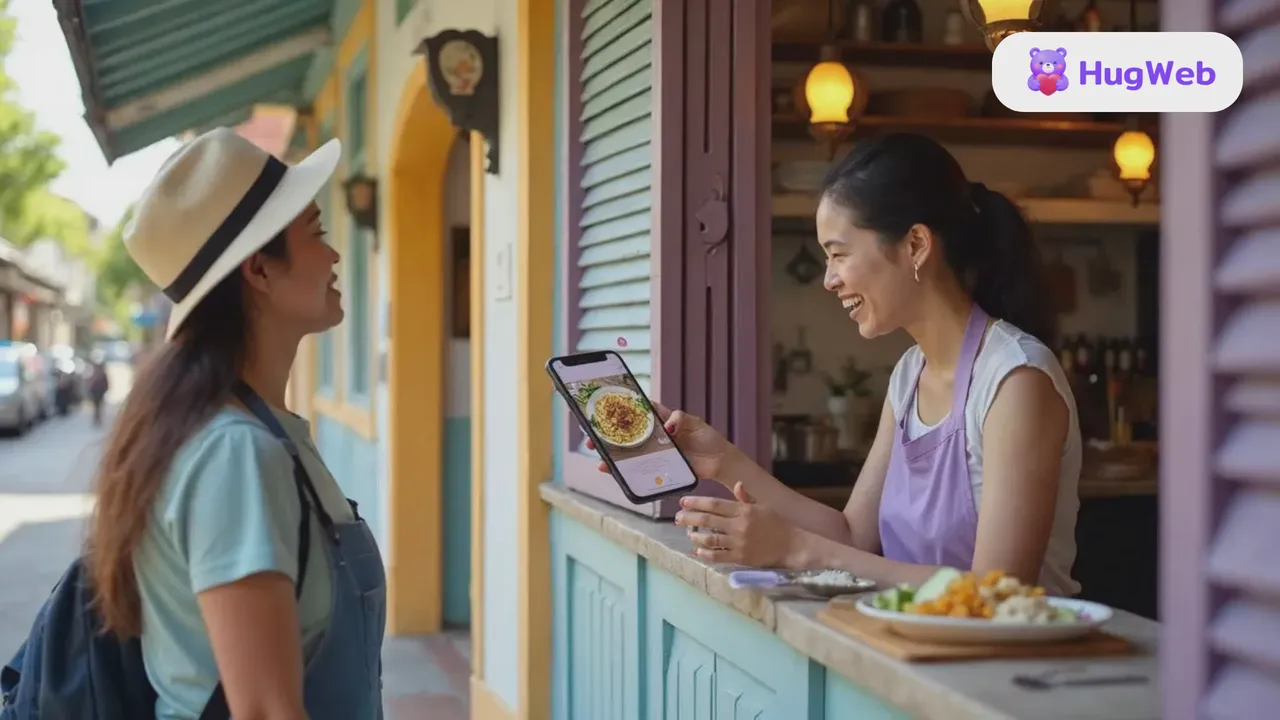
Picture a Hainanese chicken rice shop in Phuket Old Town. It has been busy for years, mostly with regulars from the neighborhood. Lately, though, the owner notices foreign tourists walking past every day. Some stop and look at the Thai-only menu board for a moment, then walk on to the next shop, the one with photos and prices in English. The owner hasn't done anything wrong. These customers just can't read anything about the shop.
I think a lot of shops in tourist towns run into this. In this article we'll look at how a bilingual website helps a shop like this one, what an English page needs to say, and how much you actually need to translate before it's useful.
How many foreign tourists visit Thailand?
According to statistics from the Ministry of Tourism and Sports, 32,974,321 international tourists arrived in Thailand in 2568 (2025). This is preliminary data, which the ministry may revise later.
The five largest markets were Malaysia with 4,520,856 arrivals, China with 4,473,992, India with 2,487,319, Russia with 1,898,837 and South Korea with 1,555,227. Visitors from Europe as a whole added up to 8,250,165.
What do these numbers mean for a small shop? First, foreign customers don't come from one country, and each group has its own first language. A small shop can't build a site in every language, so English is the first language worth adding, because people from many countries can use it to read the same information. Second, Chinese visitors were the second-largest group, so if you see Chinese customers often, Chinese is a sensible next language.
Which shops should have an English page?
I don't think every shop needs a bilingual website. If nearly all your customers are Thai locals, a complete Thai website will do more for you first.
Shops that should start thinking seriously about an English page usually look like this:
- They are in a neighborhood or province where foreign tourists walk past every day
- Customers have to decide before they arrive, such as tours, spas, guesthouses, cooking classes or restaurants that take bookings
- Foreign customers keep messaging the same questions, such as prices, opening hours or how to get there
- The product or service needs explaining, such as ingredients, what is included or how a treatment works
If your shop matches two or more of these, an English page usually makes a clear difference.
What your English page needs to say
A tourist looking at a shop's website usually has only a few questions. Where is it? When is it open? What do they sell, and for how much? How do I book or get in touch? An English page that answers these clearly works better than a long translation where the answers are hard to find. Here is the main information I recommend.
Where the shop is
Add a map that opens in a maps app, plus landmarks written in English: which train station is nearby, which temple you're opposite, or how many minutes' walk from the walking street. Spell street and soi names the way they appear on the real signs, so visitors can match them while they look for you.
Opening hours and days off
Give clear opening hours and your regular day off. If you close for festivals such as Songkran or Chinese New Year, say so ahead of time. A tourist who travels across town and finds the shop closed rarely comes back.
Menu or services with prices
Price is one of the biggest factors in a tourist's decision. Show prices in baht and say what each price includes. Restaurants should show a photo next to each dish, because many Thai dish names make no sense when translated word for word. Spas should give the length of each treatment, and tours should say whether the price covers transport, entrance fees or meals.
How to book or get in touch
List the channels you actually answer, and write your phone number with the +66 country code so people on foreign SIM cards can call straight away. If you take messages on channels other than LINE, list those too and let customers choose. It also helps to say when you can reply to messages in English, so nobody waits too long for an answer.
How to pay
Say clearly whether you take cash only, cards, or which kinds of transfer. Many tourists don't carry much cash, and knowing in advance lets them come prepared.
Details for your type of business
Beyond the basics, each type of business gets its own questions from foreign customers:
- Restaurants and cafes: how spicy dishes are, vegetarian options, and common allergens such as peanuts, shrimp or milk
- Spas and massage shops: how long each treatment takes, whether to book ahead, and whether there are rooms for couples
- Tours and activities: pickup points, departure times, what to bring, and the cancellation policy if it rains
The lists above cover the main information that works for most shops. Yours may have other questions that come up often. The easiest way to find them is to scroll back through your chats, see what foreign customers keep asking, and put the answers on your page.
Example: an English page for the chicken rice shop
Let's go back to the chicken rice shop in Phuket Old Town from the start of this article. If the owner already has a Thai website and wants an English page they can finish in an afternoon, this is the order I'd suggest.
Top of the page. Show the shop name in both Thai and English, side by side. The real sign out front is in Thai, so this lets visitors match the page to the shopfront when they arrive. Add one short line about what you sell, such as "Hainanese chicken rice, family recipe", and put a map button right next to it.
Location and hours. Spell the street name the way it appears on the sign, and say how far the shop is from somewhere visitors already know, such as how many minutes' walk from the clock tower. Then give opening hours and the day off. If you close early when the chicken sells out, say so plainly, so customers know to come before noon.
Menu. You don't have to translate every item. Pick five or six best sellers, use a real photo for each one, and write the dish name the way a foreigner can say it out loud. Follow it with a short description: steamed or fried chicken, whether the sauce is spicy, and the price in baht. If any dish can be made without meat or without chili, say so here.
Payment and contact. Say whether you take cash or which QR payments work, whether you do takeaway, and give your phone number in +66 format along with a messaging channel you actually check.
None of this is long, but it answers the questions a tourist has before they even leave their hotel. Once that first page works, add the shop's story, such as the recipe handed down in the family or how locals eat the dish in Phuket. Tourists often enjoy reading that and like to share it.
How much do you need to translate?
Many shops hold back because they think the whole site has to be fully translated before it can go live. I understand the worry, but in practice, starting with the parts customers use to decide already helps a lot.
The order I recommend:
- Shop details, location, opening hours and contact channels
- Menu or services with prices
- How to book and how to pay
- The shop's story, articles and other details, when you have time
One thing to watch out for is translating only the navigation menu and footer while leaving the main content in Thai. Google's guidance says that translating only the boilerplate while the main content stays in a single language can create a bad user experience, because visitors arrive and still can't read what they came for.
As for using AI to translate, it saves a lot of time today. But some information should always be checked by a person: prices, booking and cancellation terms, ingredient and allergy information, and dish names that are proper names. If nobody at the shop is confident in English, ask a regular customer or a friend who uses English to read it through once.
Help Google find your English page
Once the English page exists, tourists still need to find it. Google has clear guidance for multilingual sites. In plain terms:
- Give each language its own address. Google recommends a separate URL for each language version, for example the English page under /en/, rather than switching languages with browser settings.
- Tell Google which page is in which language. This is done with hreflang, a tag that helps Google send people to the version in their language.
- Don't switch languages automatically. Google advises against automatically redirecting people to another language based on a guess about their device, because it can stop both people and Google from reaching some versions.
- Let customers pick the language. Put links to the other language versions on the page so visitors can choose the one they read comfortably.
It sounds technical, but shop owners don't have to set all of this up themselves. If your website tool handles it, your job is to keep the English content correct and up to date. If you want a stronger base for showing up on Google, the basic SEO checklist for SME websites is a good next read.
Add an English page in HugWeb
In HugWeb, your website is built in Thai first. You can then add other languages, such as English or Chinese, from the Language tab in your site settings. Each added language is a paid add-on charged per language. You can find the latest details on the HugWeb pricing page.
The steps, in short:
- Finish your Thai website first, with location, opening hours, menu, prices and contact channels
- Add the language you want in the Language tab
- Let AI translate the content
- Check the translation. The Thai text is shown next to each translation, so you can edit each field yourself or clear a translation to fall back to the original
Step 4 is where I'd spend the most time, especially on prices and terms, as described above.
On the Google side, I checked sample websites built with HugWeb. The English version lives under /en/, the pages carry hreflang tags for both Thai and English, and the site does not switch languages automatically. That matches the Google guidance in the previous section, so you can focus on the content.
If your shop doesn't have a website yet and you're weighing whether you need one when you already sell on a platform, why your business needs its own website is worth a read. And once foreign customers start messaging you, how to move customers from your website to a chat and close the sale will help you keep them from dropping off.
Summary
More than 32 million foreign tourists in 2568 (2025) are an opportunity for shops in tourist towns, and often the only thing standing between a shop and those customers is language. An English page that clearly gives your location, opening hours, menu, prices and contact details lets customers decide to visit before they leave their hotel. Start by translating what customers use to decide, have a person check prices and terms every time, and add the rest as you have time.
If you're not sure where to start, try describing your shop in a quick chat on HugWeb. Get your Thai website in good shape first, then add English when you're ready.
Frequently asked questions
Does a bilingual website need every page translated?
Not on day one. Start with the information customers use to decide: location, opening hours, contact channels, menu or services with prices, and how to book and pay. The shop's story and articles can be translated later, but translate the main content of each page you publish, not just the navigation menu.
Can I use AI to translate my English page?
Yes. AI saves a lot of time, but a person should always check the details that hurt customers if they are wrong: prices, booking and cancellation terms, ingredient and allergy information, and dish names that are proper names.
Should a shop in a tourist town add Chinese as well?
It depends on your customers. Preliminary 2568 (2025) statistics from the Ministry of Tourism and Sports show 4,473,992 arrivals from China, second only to Malaysia. If you see Chinese customers often, Chinese is a sensible next language, but if you don't have an English page yet, start with English.
What currency should prices on the English page be in?
Thai baht, because that is what customers actually pay at the shop. Also say clearly what each price includes, such as whether a tour covers transport or entrance fees, or how many minutes a spa price is for, so there are no surprises at the till.
What contact channels should I list for foreign customers?
List the channels you actually answer. Write your phone number with the +66 country code so people on foreign SIM cards can call straight away, add any messaging channel you use besides LINE, and say when you can reply to messages in English.
How can a shop with no strong English speakers keep an English page up to date?
Use AI for the first translation, then ask someone who uses English, such as a regular customer or a friend, to read through the prices, terms and dish names. Whenever you change a price or your opening hours, update the Thai and English pages at the same time.